On Thursday, November 13th, Susan had a significant new pain crisis that has turned the page on a new chapter of this journey. The standard treatment for pain of course, is to increase pain medication, in this case morphine. The hospice philosophy, which is all about comforting the dying, accepts no excuse for pain. Pain interferes with the important emotional and spiritual work that is being done in preparation for the transition out of this life. The tradeoff with pain management is sleep.
So Susan has been more asleep than not since that Thursday night. Even in wakeful times, she’s still in a world of her own. But she’s perfectly aware of what’s happening and has grown in her level of acceptance. The reason for the pain is undoubtedly disease progression, which means we’re getting yet closer to the inevitable beginning of a new journey for her as well as for the rest of us. Underscoring that reality has been the breathtaking speed of change in the household. Suddenly, we have a hospital bed in the living room, and we’re using more oxygen. Jon and I are taking turns eating and sitting with Susan who is essentially uninterested in food and no longer able to sit at the table. One of us sleeps in the living room with her at night. We have meals and pastors, and professional caregivers coming and going on a regular basis. Friends and family are right here with us both physically and spiritually. Sponge baths and changing the bed and lots of laundry are now the norm. Susan hasn’t been upstairs since Saturday morning because getting her up and down stairs has become too adventurous. Her favorite recliner in the family room seems like a distant memory. Just in the last few days, our lives have been transformed into the picture of in-home hospice that many of us probably imagine – and maybe dread. She has swiftly become bedridden and dependent on us for nearly all of her needs. Susan and I have discussed this picture many, many times over the last 4 ½ years – and here it is for real.
A wonderful friend of ours, Helen, offered an amazing metaphor to all of this. Helen suggests that Susan is in labor again. But this time it’s to give new life to her soul as her body dies. As I was sitting in the living room reading and contemplating our circumstances, trying to decompress from all of the new stressors that this has produced, I suddenly became keenly aware of what in-home hospice is all about – and it’s a lot like trying to make childbirth as comfortable as possible in familiar surroundings. Much of the stuff you’d expect in a hospital room is right here in our living room. We even have one of those over-the-bed tables on wheels that can be raised and lowered and upon which hospital meals are served. But it’s still our living room – with new meaning to the term “living” – not a stark, unfamiliar, and unpleasant place. I’m reminded that most of the literature we’ve read about the hospice movement emphasizes that dying is actually part of living – for all of us. We need not treat it as a failure of some sort. Doesn’t it make more sense to acknowledge its reality and deal with its inevitability by exercising as much control over it as we can? Prior to “modern” medical technology, isn’t that what people used to do? Die at home? Give birth at home? Susan occasionally wakes up, looks around, makes an observation, and resumes her slumber. The other day she commented “we have a nice living room!” Point made.
Jon’s prior CNA experience in a nursing home has proved to be invaluable. He’s teaching me all the tricks. But the new chores that Jon and I have taken on are unpleasant and exhausting – and not just for us. Susan, even though she’s not the same coherent person we’ve known, clearly doesn’t like any of this either. We had hoped to avoid this stage. But the fact that we’ve had so much time to prepare for this is a gift. We’ve read a great deal about hospice and the dying process – and I’m beginning to understand why it can be an honor to be a caregiver to a loved one.
Uncertainty is still part of the process. Though things have changed rapidly in the last 13 days, we still don’t know when she will be able to let go. She doesn’t either. We only know we’re closer than we were before. Patrick was here for a few days last week and will return for the Thanksgiving break. Instead of the usual Thanksgiving custom, the four of us will be giving thanks in a very special and memorable way – for the gifts of life and love, and especially for the extraordinary legacy of Susan Diane Given Moody.
Wednesday, November 26, 2008
For Real


Sunday, November 9, 2008
Urging Us On
When I was about 15, I walked the Lincoln Trail as a boy scout. The Lincoln Trail retraces the path that Abraham Lincoln walked between Springfield, Illinois where he was studying law and New Salem where he was living in the mid 19th century. It’s 20-plus miles – a pretty long trek for a youngster, especially if the youngster isn’t in the best of shape. But my brother and my cousin had both done it and I wanted to do it too. Hiking the trail earns the scout a medal and a big sense of accomplishment. Besides being dead-tired toward the end of the long day, I remember feeling lonely during the journey, even though I was with a small group of others who urged me on. I probably wouldn’t have made it without that support.
This memory could be a metaphor for our cancer journey. Susan, Jon, Patrick, and I are all experiencing this trek in our own ways, and I think it feels a little lonely for each of us even though we have lots of people urging us on. I don’t know how people do this without the encouragement of others because getting to our destination is a long trek. As with many life experiences, hiking the Lincoln Trail must have been part of my preparation for this time in my life.
Lately, the show of support has been particularly evident from all of you. We’ve gotten loving, non-invasive messages in all kinds of ways and from all sectors of our lives. Some of the messages have become dependably regular and are our bedrock. Some of them have been unexpected and gratifying surprises. The number of people who are with us on this journey is astonishing, and humbling, and touching. It illustrates the best of our humanity as we travel the circle of life together. It is what will help us make it. In spiritual terms, all of you equate to the presence of God in our lives – and God is mightily present.
In the last month Susan has gone from what had been pretty stable pain control to sudden, severe new pain. After a couple of weeks of increased doses and being “out of it”, she seems to be in a little better control of the pain for the time being. Her memory and cognitive abilities are still pretty variable from one moment to the next. She struggles with the loss of function. We know pain management will be an on-going challenge. Stability and mobility are growing issues and all of us are fully exercising our coping skills as we strive to keep her safe, comfortable, and at peace with the situation. It’s already been a long hike and we don’t know how far we have yet to go. The sense of accomplishment we seek at the end will be helping Susan finish her earthly life in peace and comfort. But we’ll make it – because we have you urging us on. God is with us. Thanks be to God – and to you!
Sunday, October 5, 2008
Letting Go and Holding On
One of the challenges Jon and I have noticed about this journey as caregivers, is how very difficult it is to find the right balance between assisting Susan with a task and assisting her with her dignity. It’s very hard for Susan to let go of things that she can sometimes do, but sometimes can’t or sometimes shouldn’t. It’s usually little things – like carrying a glass of water around the house or a handful of stuff up and down the stairs. It could be something very important to her but not so much to us when we have so many other priorities on our minds. Sometimes, it’s no problem at all. Sometimes she can’t do it safely and knows it. Sometimes she can’t do it safely and doesn’t know it but Jon and I do. And sometimes we’re mistaken. Part of the dying process is learning to let go of things and we talk about that a lot. But as Susan points out, it can’t be done overnight, especially for someone who has always been so competent. Knowing exactly how best to get someplace or where to park doesn’t go away just because you’re not the one driving. Taking things away from her – even with all our good intentions as caregivers – sometimes results in some verbal wrangling, albeit brief, that only adds to the stress of it all.
I think parents and teachers get lots of practice at the process of helping, then letting go as children grow, develop, and master new things. Experiencing that is both scary and rewarding. But this is just the opposite. We’re not talking about someone’s development; we’re dealing with someone’s decline. We’re not the ones letting go – she is. I noticed the same difficulties when my sister was the primary caregiver to our mother. The caregiver wants to help, to take annoying tasks away, to keep the loved one safe, and to balance all of that with whatever the caregiver needs to do for himself. But the loved one wants to reaffirm her own value as a competent human, to offer thoughts, ideas, and expertise in the activities of daily life no matter how trivial. It turns out that helping someone who is not always helpless is a steep learning curve.
Because of Susan’s decline, it’s very difficult to tell from one moment to the next if we’re dealing with a sharp, rational thought process or if we’re dealing with the effects of the brain tumor. She is often confused and frequently has trouble converting her thoughts to the right words – but not always. Short-term memory is a big problem. In addition, her mind is tormented by an overwhelming, sometimes anxiety-producing flood of thoughts. Some of those thoughts are constructive, accurate, and right on the money. Sometimes they’re not. Often, they are things we don’t think she needs to worry about. But when we step in to rescue her from being a hostage to her own unnecessary control needs, we sometimes get a backlash because she’s unwilling or unready to give up the dignity of having thoughts and choices. It’s very stressful and takes a lot of energy for the caregiver to figure out the right response. In fact, it’s probably impossible – which adds an element of guilt for not getting it right.
Her decline is more and more obvious. For several weeks, pain management has been a growing issue. We’re constantly trying to determine how much regular, baseline pain medicine she needs in order to avoid too much breakthrough pain yet not so much that she falls asleep in the middle of a sentence. The more morphine she takes the more cognitive function she gives up. The less morphine she takes, the more she’s in pain. Her balance and mobility are much worse. She uses a walker more and more, even in the house. Her risk of falling is considerably higher. She uses oxygen occasionally for shortness of breath (that was particularly handy for our recent visit to the higher altitude of Estes Park). And yet she continues to formulate future plans and future projects and hold on to as much as she possibly can. It turns out that the dying process is much more complicated than I ever anticipated, even though we’ve been informing ourselves about it for years.
How will Susan know when it’s time to let go and die in peace? How will the rest of us know when to signal to her that it’s OK? There is only one answer that consoles me: We have to let go of our human concerns and hold on to our faith in God, Nature, the Divine, or whatever superior force we rely on to help us cope with life’s challenges.
Let go – but hold on. It takes a lifetime to master.
Wednesday, September 3, 2008
How do you say good-bye . . .
. . . to your parents, your sister, your brother and all the rest of your loved ones when you’re dying?
Susan’s parents were here for a brief visit in early August, followed by her sister Barb with her husband Jack later in the month. Her brother Scott and his wife Jan will come for a short visit in late September. In each case, we all know that it may very well be the last time they see Susan again.
But as sad as that sounds, there are blessings in all of this – just as we’ve said about the whole cancer journey. How often do we take the opportunity to really pay attention to our loved ones, to listen to them, and appreciate them rather than taking our relationships with them for granted? When you add the element of dying into the mix, everything changes – especially if it’s not following the usual order of the older folks dying first. Susan and her family are as close as they’ve ever been – and that’s a good thing.
So, how do you say good-bye to loved ones when you’re dying? Maybe it doesn’t matter as long as you somehow focus on what makes them your loved ones to begin with.
By the way – how is Susan doing?
We continue to experience ups and downs, often several times in the same day, with a gradual downward trend. Everything is slowly happening as expected. Susan’s pain is pretty well managed most of the time, but her cognitive abilities and emotional reactions to things are noticeably affected. She has trouble with short term memory and gets easily confused or upset or overwhelmed. Someone is always with her when she leaves the house and most of the time at home as well. Her balance and mobility issues require a cane or a walker. But she continues to maintain a great deal of control of her day-to-day tasks. She is continually knitting multiple projects, mostly for others.
Jon is at home most of the time on weekdays and I primarily do evenings and weekends. Jon has a part-time job and is taking a class – both of which help keep him alternatively occupied. Patrick worked at scout camp until early August, and then was part of the care-giving mix for a couple of weeks before returning to Bozeman last weekend for the beginning of his semester. It’s a unique challenge for him to be there and not here. My work is going well and my co-workers are wonderfully supportive. I try to take a little time for myself now and then but my plate is full and I will sit out of choir for the time being.
Jon, Patrick, and I can tell you that this is hard and getting harder. I watched my sister deal with the challenges of eldercare with our mother. There are lots of similarities. But as my sister pointed out, such difficulties are not unexpected when your parent is ninety-something. When as in our case, it’s your soul mate with whom you had retirement dreams, or your mother who would relish a chance to someday hold your own children – there is an extra overlay of emotional difficulty. We’re exercising our coping skills, practicing our faith, and feel deeply appreciative of a supportive community.
Thank God for all of you!
Friday, August 22, 2008
Stateside and Back
We have a guest blogger for this entry. This posting is from Lisa's Peace Corps Blog, writing about her recent visit in late July. Rob
I tactfullly avoided mentioning to too many people that I would be making a stop in the states for a bit, just as I have been tactfully avoiding writing anything about my trip there. Well, I think it's about time I talked. It's strange to think of an experience as both rejuvenating and energy-sucking. B/c that was what America was. Essential and exhausting, wonderful and heartbreaking.We have all changed so much whether we were aware or not: Susan, me, Jon, Sarah, family and friends. It's amazing how distance can put such a real and invisible gap between what we all understand about one another. And how that enables us to just grow up more, i guess.Susan was my reason for going back where i came from. So I went. Things were different. Some of it was sad and real. But it was what it was.I saw both a different woman and the same woman in her. I saw a woman who still loves her crafts, who still wants to be with her friends and get her nails done and have the classic "Moody" conversation that we have at their dinner table, usually on the verge of politics or religion, or life in general. I also saw her frustration in losing her independence in all these activities as well. The ultimate reality that it will not get better, and wondering, just how the hell do you say goodbye to someone...for good? I managed to leave there with thoughts of not being sad for Susan because she knows what she wants and how to go about her plans as best as she possibly can. But plans are just hopes. And we hope we can carry them out against all odds. I cannot honestly say that i am not worried for her within the next few months, but I was happy to see that she is able to make her decisions, able to prepare herself and her family and enjoy what time has left to her. I saw her trying to embrace her own person, on her own, as well as giving what time she can to others. I think all of us would want to give this time to those we love. And I can see Susan doing this both because she needs her family, but also because she knows that we need her. What greater show of empathy for those of us behind her than to get time with her, cause that's all we got to work with. Jon, Patrick and Rob are a bit of another story for me. I do worry for these men and how they will cope. I also (saw) 2 different Jonathan's back home. A caretaker, all business at times and just as frustrated as his mother was. His trade-mark patience could wear-thin. He even found it hard to "please" me one time when I snapped at him for no good reason. That's when I thought that I am not so sure that he is aware of what he is doing exactly. And that is his very best. His best to love himself, the best to love his mom and take care of her, the best to alleviate any stress on the family. His best to hold it together as a part of his world changes before his eyes. And this all just made me realize, for only the millionth time what a good heart he has. And how proud I am to be a piece of it. And it would be a lie if I said that being in Uganda wasn't some sort of escape for me. It is. I have another focus here, another life, really. That is the best and worst part about being here, maybe: the separation from my point of origin. But, this is life. Everyday we all die a bit, we grow a bit, we lose something and replace it with something else. What is most important is that we learn a lot and play a lot, like my papa preaches and do what we can to connect to others. Can I end this on a morbid note? "Love is watching someone die"And I hope that I can get a chance to be with those I love when they end their time here. Life is nothing special if it does not hurt. And I am ok with this.
Created for your enjoyment by Lisa B at 7:31 AM
Sunday, August 10, 2008
Here's to Jon!
Our oldest son, Jon just turned 25 – an age when most people are focused on their own lives, their own future, and developing their own ways of meeting the challenges of life. Most of us did not have to deal with the reality of a dying parent as part of our early adult experience.
Jon graduated from Colorado State University in December of 2006 with a B.A. in History. His plan at the time, along with his long-time girlfriend Lisa, was to enter the Peace Corps and serve the world in a uniquely meaningful way for a couple of years. He and Lisa applied and were both accepted. The screening process was long, and even after their initial acceptance they each had to endure a multitude of psychological and health tests. Never-the-less, the process was leading them to Africa where they both wanted to go. They wouldn’t have been serving in the same place, but they’d have been on the same continent doing what they had long committed to do. But in the summer of 2007 after months of delay, Jon was finally informed of the Peace Corps’ reluctance to proceed while his mother was dealing with a terminal illness. At the time, we had no way of knowing where Susan’s disease process would take us, or when. But the Peace Corps has a great deal of experience in these matters and knew that the loneliness and isolation of an assignment in Africa would be arduous – and that any major family crisis, let alone her death, would threaten his experience and that of the community he would be serving.
While Lisa’s plan moved forward, Jon took the disappointment in stride and looked for alternative opportunities closer to home. He ended up joining an AmeriCorps program called the National Civilian Community Corps. He left in late January for what would have been a year-long assignment based in Maryland, just a week before Lisa left for the beginning of her Peace Corps assignment. She went for an orientation in Philadelphia first (where she and Jon were able to rendezvous), then went on to Uganda where she is currently serving. It was shortly after that when we found out about Susan’s brain metastasis and that we had entered a new chapter in the journey. After several months doing post-Katrina projects in Biloxi, Mississippi, Jon decide his calling was at home. He arrived back in time to join me in the emergency room on a day when Susan was dealing with the medical crisis that helped us decide to enter hospice two days later.
Jon put his life on hold and chose to be with Susan as a caregiver. He has training as both a certified nurse aide and as an emergency medical technician which has come in quite handy. Early in the hospice journey the going was relatively easy and his presence was simply appreciated. Now, looking back over the last three months I can’t imagine doing this without him.
Jon’s role is more complicated than it appears. If he were just being employed as a companion, he might be able to go off duty and retreat to his own living space. But he’s also a family member dealing with the end of his mother’s life. There’s no “time off” for that. Though he found being thousands of miles away very difficult, he’s now dealing with the challenges of being so close. At any given time, he’s taking Susan where she needs to go (he’s not very fond of the craft and fabric stores she frequents), doing chores around the house, helping her with her meds, or observing her symptoms and behavior. (Such observations are critical for the hospice team in order to monitor changes and make necessary adjustments for Susan’s comfort.) All of that has become much more complex and challenging in recent weeks. Susan, by her own admission and because of her brain tumor and meds, can sometimes be a pretty crabby patient. Jon usually bears the brunt of her physical and emotional symptoms because he’s with her so much. But Jon is also processing his own journey. He’s trying to figure out what to do and where to go after Susan is gone. He’s trying to keep up with Lisa and her separate experience in Uganda, both to lessen the anguish of her absence, and to be supportive of her. He’s experiencing losses and learnings that most young adults don’t experience until much later in life. And I know he has days when he wonders why he has to endure all of this.
We all have our ways of coping. Jon works out a lot. He plays with the dog, he has two part-time jobs that get him out of the house, and he is exploring future opportunities. At Jon’s Eagle Court of Honor in 2002, I said I had begun seeing him as my own role model, rather than the other way around. I don’t know how I would manage what Jon is handling if I were his age. But I admire the heck out of what he’s doing. I know that as difficult as this is on so many levels, that he’s been gifted with the unique ability to do this and do it well. I believe he’ll be an even better person for this experience, difficult though it may be.
When I told Jon I was writing about him, he asked “is it good?” He’s not looking for accolades. He’s not that kind of guy. But I think we all need support in dealing with this journey at the end of Susan’s life. Some of my support comes from him. He deserves our support too. So please raise your glasses and join me in a toast.
Here’s to Jon!
Monday, July 28, 2008
A Susan Health Update
It’s time for an update on Susan’s physical, emotional, and spiritual health. Some of what I tell you is brutally honest, but she wants people to know these things and has asked me to be frank. It turns out that the process of dying is more complicated than we imagined. She is not bed-ridden or home-bound. She has no tubes or needles entering or exiting her body. In most ways, you wouldn’t know this person is dying, let alone in a hospice situation. But the reality is that she is slowly declining both physically and emotionally. The good news is that her spiritual health has probably never been better.
Physically, she has the tell-tale “moon face” (which she hates) of someone who has been on steroids for a while and she uses a cane or walker outside the house. But beyond those minor observations, you might not realize all the other things that are going on. She does her hair and nails. She wears jewelry. She is as impressively well-dressed as ever. On any given day, she’ll have periods when she feels well and enjoys knitting, reading, or listening to a book. But she’ll also have periods of fatigue or discomfort. Afternoon naps have become an important way to conserve or renew her energy. She has to limit the number of things and people on her daily agenda (very hard for her). Too much to think about saps the energy right out of her. Issues with fine motor skills have affected her hand-writing and the handling of small objects (like pills). She has neuropathies in her feet that come and go but are coming and going a little more often. Balance and mobility have decreased (thus the cane or the walker) and her left foot won’t cooperate when she walks. She is mostly pain-free (due to regular baseline pain management) but occasionally has severe upper abdominal pain that requires additional narcotic intervention or scalp pain near where the pins of her gamma knife “helmet” were attached. Some time ago, her colon stopped working normally and finding and maintaining the right balance of substances to prevent great discomfort from either unwanted extreme remains elusive. She lost most of her ability to salivate and some of her taste from earlier radiation treatments. Combine all of that with short-term memory loss and occasional confusion and you’ll get an idea of what things are like for her on an on-going basis.
Emotional health is also a struggle. The prednisone is partly to blame because not only does it produce the despised “moon face” and weight gain, it also sets the stage for an emotional roller coaster that can find her angry and grumpy one minute and crying the next. For those who know Susan well, you know that she has always been a self-directed, “in-control” achiever. To lose so many physical abilities and to let go of things she can no longer manage is extraordinarily difficult for her. Jon or I need to be with her when she takes her meds to explain why this or that has changed, to help make sure she’s taking the correct day’s doses, to find the ones she drops, or to just keep her focused on the task. She hasn’t driven since late April or early May. During the periods when she is feeling reasonably well, it drives her nuts to be dependent on others (primarily Jon and me) for transportation. At other times, she realizes why things are the way they are. But for this highly intelligent, capable, accomplished person – it sucks. In addition to the fatigue, over-stimulation causes anxiety. That’s why you rarely see her in large group situations any more. She likes occasional short intimate gatherings although they are taxing.
But just as she has declined in physical and emotional strength, her spirituality has grown with this experience. Everything that is happening to her is supposed to be happening in this process – and she knows it. While so many others among us are avoiding the subject of dying and death or resisting it in angry denial, Susan is facing the end of her life with firm resolve to leave the rest of us more enlightened for the experience and to leave a legacy for the grandchildren she’ll never meet. She has a quiet confidence that her life has been meaningful and she looks forward to discovering how it will continue in some way beyond her earthly existence. When we gather at Montview for her memorial service, we will have no trouble acknowledging our grief, but we will be equally passionate about celebrating her life. She will have shown us a way to live and a way to die that will enrich our own journeys in life and in death. Anyone who spends time with her can easily acknowledge the sadness of her physical and emotional decline. But one can also discern - just beneath the surface of the obvious symptoms – another deeper, ultimately more important reality about our existence. We have to look past the sad stuff to experience it but it’s there. It’s uplifting and inspiring and it calls upon us to grow our own spiritual awareness.
So in that all-important sense, I’m happy to report that Susan is well.
Monday, July 14, 2008
Questions about Courage, Hope, Faith, and Love
Many people have used the word “courageous” to describe us on this journey, especially referring to Susan. The affirmation is as deeply appreciated as it is confounding. We don’t feel particularly courageous or heroic or anything else. We often look at each other and wonder what other choices do we have? How else would anybody do this? Who would you not call courageous?
The dictionary defines courage as: Mental or moral strength to venture, persevere, and withstand danger, fear, or difficulty. OK, I guess we have developed some of that. But the question remains: what else would we be doing otherwise? What would people who lack courage do?
The opposite of courage is “cowardice” meaning: Lack of courage or resolution. Not much help there. But the term “lack of” does suggest that courage and cowardice can be displayed in degrees. So where are we really on the scale? What is “average” or “par” or “acceptable” on the courage scale? When does courageous behavior slack off enough to become cowardly? And who’s got the scale? What do cowards do?
In some sort of dangerous situation, cowards could be expected to run away. But running away doesn’t seem to be an option here – at least not for Susan. The closest thing to it is probably denying the reality of a situation. We probably all know people who seem to do that. But how do we know someone’s “denial” isn’t their sense of hope or faith – and isn’t that related to courage? Since we know that a person’s outlook affects his or her health and well-being, who gets to decide when someone’s hope (or faith) is out of whack or unrealistic? Is false hope “false” just because we think it is? Is clinging to life an act of cowardice or courage? What about letting go of life? Journeys like this present all kinds of courage vs. cowardice moments: getting the diagnosis (particularly if it’s incurable, like melanoma); deciding what clinical trials to try; deciding when the toxic results of treatment are worse than the end result of the disease; handling the side effects from damage already done; deciding when and how to prepare for the end of life. We’ve come to understand that the “right” answer is deeply personal. When Susan decided it was time for palliative care, our pastor Bill told Susan that she didn’t choose death, she chose life – and to be fully alive each moment of the day. This is why our friend Heidi said “Don’t let anyone tell you how to do this.”
In his famous first letter to the Corinthians, Paul writes about faith, hope, and love enduring forever. Indeed, these circumstances force one to contemplate things like spirituality, relationships, dying, death, and eternity. Our culture, particularly Western medical culture in the last century or so tends to regard death as a failure to survive. If that’s true, then aren’t we all doomed to failure? Susan’s oncologist points out that as much as we’d prefer to live to a healthy old age and die in our sleep, it only happens that way for some people. Who do you know that hasn’t experienced the unexpected, premature, or otherwise unfair, agonizing death of an acquaintance, a friend, or a loved one? Don’t we all have some experience with this reality? So why do we as a society consider death to be such a failure? Why do we tend to put off our reconciliation with the inevitable until it’s either undeniable or too late? Is that cowardice and avoidance of pain, or is it simply our instinct to survive?
One of the blessings of a long journey is coming to terms with all of this. It’s an evolutionary process that involves gathering as many facts as you can and blending them with as many possibilities as you can imagine and testing them with your own developing beliefs. We’ve had a lot of time to do that. Much has been written about this. A few of our favorites are referenced on this blog. In particular, the book “The Anatomy of Hope” has been helpful to us.
If you think we’re courageous, please don’t stop telling us. It really helps to hear it. But also ask yourself what you’d do or what you have done in similar circumstances. Wouldn’t it be similar? This is an amazing opportunity for us all to reflect on our humanness and be more aware of the meaning of life. I suppose it takes some courage, and a good deal of faith, hope, and love to face that.
Sunday, July 6, 2008
Expressions of Love
People demonstrate love in lots of different ways, and not always with words.
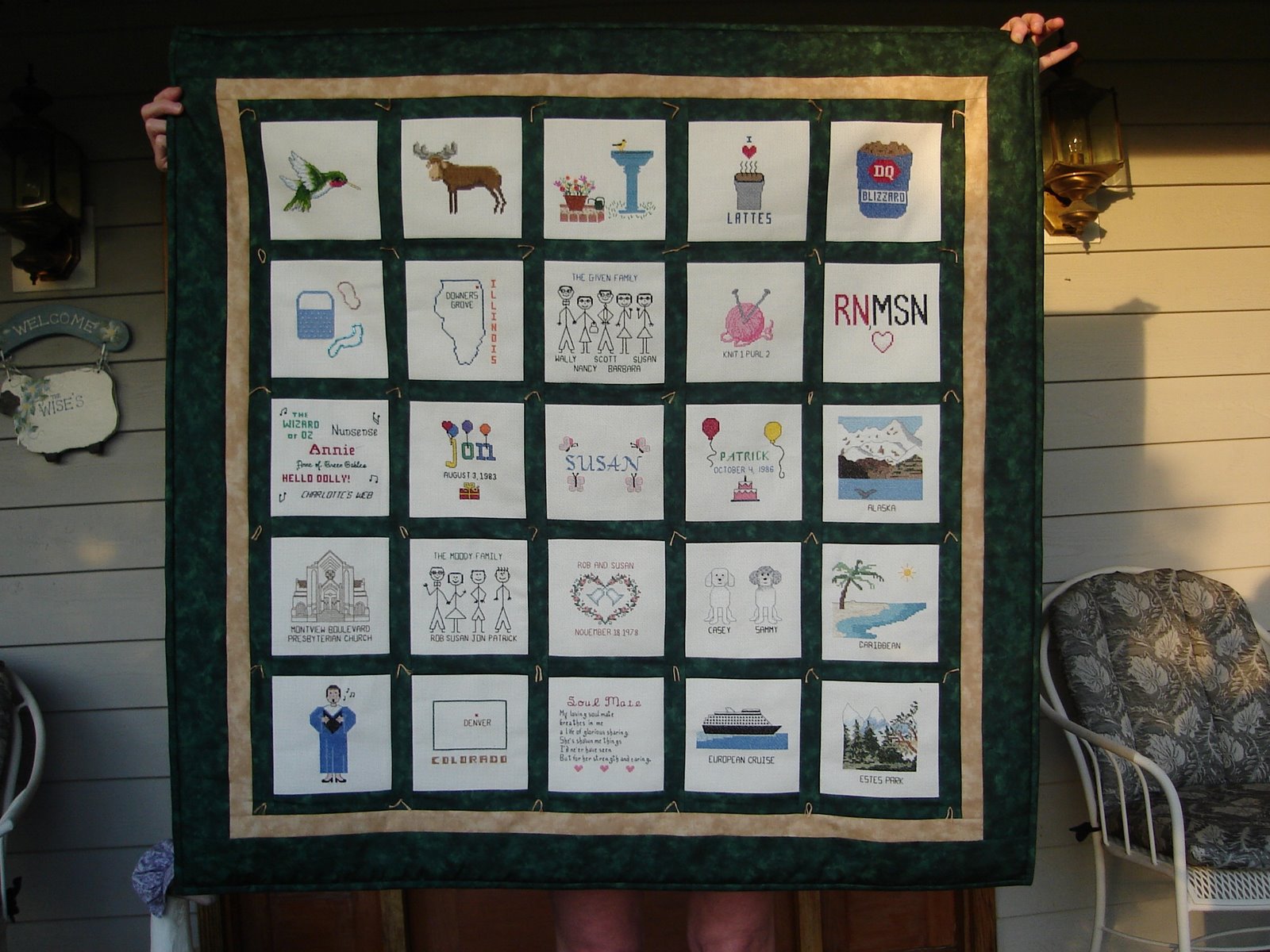
Susan’s sister Barbara completed a memory quilt in honor of Susan which you can see pictured to the right and also in the “Susan’s Family Album” slideshow. It has 25 squares representing some of the most important things in Susan’s life. Looking at it from right to left and top to bottom, here is the meaning of each creation:
The hummingbird is a symbol in the Melanoma community, known as the “Wings of Hope”. You can read the story on the Melanoma Research Foundation website. A link to it is in the lower right of this page.
Ever since our first trip to Alaska in 2004, we’ve loved the moose image. In various places around the house, we have stuffed moose, carved moose, moose sculpture, moose t-shirts, a moose apron, and even a moose bird-bath! A moose had to be in the quilt!
Susan’s gardens, developed over our eleven years in this house, are her pride and joy. They’re an important part of our backyard sanctuary, along with the bird feeders and the bird bath. We love Barbara’s design and the fact that she even included a watering can!
Lattes and Dairy Queen Blizzards are staples. Aren’t they for everyone?
Susan has always been interested in crafts. For a while during this journey, Susan did beading and accumulated a large inventory of necklaces, bracelets, and other items (such as purses) adorned with beads. She has always had good taste in colors, clothes, and accessories – but with the beading, she demonstrated unique artistry.
Downers Grove, Illinois is the place where Susan grew up. It’s also where she and Rob first met.
The Given family of Downers Grove, Illinois.
Knitting is another of Susan’s crafts and one which she still pursues. In addition to her artistry in color and design choices, she finds it therapeutic.
Susan’s professional life was always focused on science and health care. Our proudest moments include the completion of her first nursing degree followed by a rewarding career in public health, particularly women’s health where she developed subject matter expertise in the uninsured/underinsured population. She was unable to complete her Master’s Degree curriculum due to her diagnosis, but she received an honorary master’s degree with the rest of her graduating classmates.
Susan and I have been involved in musical theater from the very beginning. In addition to leading roles in shows such as “The Wizard of Oz” (Wicked Witch) and “Nunsense” (Sister Hubert), Susan worked on costumes for many productions.
Our first son was named Jonathan or “Gift of God” by his grateful parents after several years of anxious efforts. Thus the great parenting adventure began!
On the other side of his mother’s name is Patrick or “Nobleman”, our second gift from God. He added a whole new dynamic to the great parenting adventure and now we are the enormously proud parents of two fine young men.
Our first trip to Alaska came shortly after the Stage IV diagnosis and was funded by a wide circle of wonderful friends. Our second trip was a cruise along the Alaskan coast last summer. Barbara’s design is beautiful and shows one of the unique topographical features of that latitude – high treeless mountains near the sea.
Our souls have been connected to each other and to Montview Boulevard Presbyterian Church in Denver since 1977. Even when we lived away from Colorado for eight years, our spiritual and social centers were still rooted to Montview. It is a very special place with very special people.
The Moody Family of Colorado.
Our wedding date. Other special dates we recognize include the summer of 1972 when we first met, and April of 1977 when we first realized we were in love.
This square depicts Casey whom we’ve had for almost two years and our beloved Sam, who died in January of 2008. We adopted Sam in 1996 and he forged a new place in our family which Casey now holds.
For our 25th anniversary, Susan and I treated ourselves to our first cruise – a New Year’s spree in the Caribbean. The Caribbean was a lovely place to revisit (we honeymooned in Cancun), and we fell in love with cruising!
Not only is Montview Church at our core, but Westminster Choir is where we have spent much of our time and where we have forged many of our life long relationships. Both Susan and I have been soloists in Westminster Choir concerts and in church services.
Our address is Aurora, Colorado, but we think of ourselves as Denverites.
This is the first verse of a poem I wrote for Susan called “Soul Mate”. One of our choir friends, Sarah, has put it to music and it will be performed at Susan’s memorial service.
Our second cruise was a wonderful voyage around Europe from Rome to Copenhagen. The picture is modeled after a Holland America ship, our favorite cruise line.
There is a reason why we live in Colorado and one of our favorite hangouts, and an icon of living in the Rocky Mountain Region, is Estes Park.
We deeply appreciate Barbara's beautiful designs, her handiwork, and most of all the love that went into this.
Monday, June 23, 2008
Getting Away
“Getting away from it all” is probably a pretty universal desire in the human experience. We all have a need to rest, relax, refresh, and re-create from the ordinary stressors of life. But the concept of “getting away” has taken on a different meaning in this cancer journey. There is of course no way to escape the reality of the situation. Susan’s symptoms – tremors, memory problems, constipation, balance issues, neuropathies, dry mouth, anxiety, attention deficit and the like – are always with her. The knowledge of what is happening also dominates what would otherwise be a routine life. But we’re learning alternative ways to “get away” in body and spirit. Our backyard is a good place to start. On a warm, sunny day (we get a lot of those) just 40 feet outside our back door, we can sit in the shade and listen to the birds and the fountain and the wind rustling through the trees. We can gaze at the wonderful variety of plants and colors – the fruits of 11 years of Susan’s gardening efforts. We can lose ourselves in a book or daydream while knitting. We can close our eyes and doze into never-never-land. (My new Father’s Day hammock is especially nice for that.) It’s a sanctuary for all living things. A squirrel made himself at home not six feet away from me yesterday while I was reading (Casey was inside at the time). We have fox, ducks, and raccoons passing through from time to time in this suburban environment where you might least expect it.
Looking back through time is something of a getaway too. We’ve been going through 30+ years of photos together. God bless Susan for keeping them organized in albums! Memories have come flooding back as we recall the circumstances of various pictures that record our history together – and realize how rich our lives have been. We both marvel at how young and skinny we used to be!
We have always enjoyed traveling – literally getting away. Many of the memories we’ve created, especially over the last five years have involved wonderful places offering expanded perspectives about our human history and diversity. However, long distance travel and especially air travel, has become more difficult and complicated for all of us, let alone for people with special needs. But short trips are still pretty doable. We especially enjoy roaming in the Rocky Mountain region – Colorado, Wyoming, and Montana. Estes Park has been one of our favorite spots over the years. Just being in a different environment – a really beautiful one at that – for a couple of days is something we relish. After only a couple of hours of driving, we are suddenly in a different world. It makes it easier to “get away” if you’re soaked in the splendor of a special place.
For us, the idea of getting away has evolved from just planning a major family vacation or a long trip to include something as simple as a latte at the local coffee shop. It’s probably as much about the choice to “be away” in our heads as it is about taking our bodies physically “away”. It takes some effort to do the head thing. While it’s only 40 feet to the sanctuary of our backyard, it’s also only 40 feet from all kinds of things that could distract us from our respite. But the very thing that requires the need for rest – this unwelcome cancer journey – also gives us the gift of perspective, making it easier to see the need to make the effort. I think this “paradoxical gift” has helped Susan decide to focus on quality vs. quantity of life – and we are all the better for it.